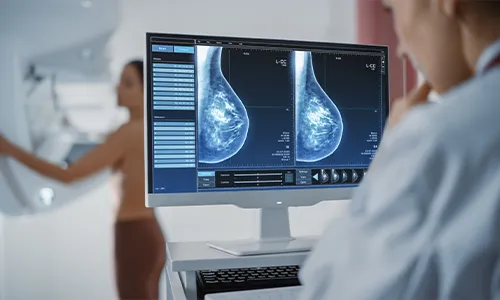
About Breast cancer
One in eight women develops Breast cancer during their lifetime, making it one of the most common cancers worldwide. Breast cancer can affect one or both breasts, which can occur in different parts of the breast, and it is an abnormal growth occurring in the breast that could spread. Almost entirely, these cases are found in women, but men can also develop Breast cancer.
About Breast cancer
Women ages 45 and older are at a higher risk of Breast cancer.
Some risk factors are:
- Increased Weight
- Alcohol Consumption
- Unhealthy Lifestyle & Diet
- Menstrual and Reproductive History
- Radiation exposure
- Late Pregnancy
- Gene Mutations
- Family History of Breast cancer
- Hormone Pills
How can it be prevented?
- Maintain a Healthy Weight
- Be Physically Fit & Maintain a Proper Diet
- Reduce Hormone Intake
- Limit Smoking & Drinking
- Avoid Birth Control Pills
Screening
Screening exams for Breast cancer help detect cancer at an early stage.
The likelihood of successful treatment is increased by early diagnosis:
- Mammography
- Breast Ultrasound
- Magnetic Resonance imaging
- Clinical Breast Exams
Symptoms & Signs
- Usually there is a painless lump to begin with however there may be pain in the breast when a breast lump has grown to involve the overlying skin
- Perforated and swollen skin throughout the breast region
- Inflammation in different parts of the breast
- A nipple discharge that is unusual and just not breast milk
- Blood coming out of your nipple
- Skin that is flaky, peeling, or scaly on your nipple
- A sudden change in your breast size
- An upside-down nipple
- A change in the way your breast flesh looks
- A lump beneath your arm
Diagnosis
Breast cancer diagnostic tests determine whether you have the disease and how aggressive it may be.
Tools and tests include:
- Lab tests
- Biopsy
- MRI or Mammogram
- Staging Tests
- PET-CT
Sub-Type of Breast cancers and Stages
- Non-Invasive Cancer
- Ductal Carcinoma in Situ (DCIS)
- Invasive Cancer
- Invasive lobular carcinoma (ILC)
- Invasive ductal carcinoma (IDC)
- Angiosarcoma of the Breast
- Inflammatory Breast cancer
- Paget Disease of the Breast
- Phyllodes Tumors
Cancer has five Stages 0 through IV
Stage 0:
At this Stage, the disease is non-invasive, which indicates that it hasn’t broken out from breast ducts.
Stage 1:
The surrounding breast tissue has become infected with cancerous cells.
Stage 2:
The breast tumor is either smaller than 2 centimeters in diameter and spread to the lymph nodes under the arms or greater than 5 centimeters in diameter but hasn’t spread yet. At this Stage, breast tumors may or may not impact the adjacent lymph nodes.
Stage 3:
Cancer has already spread past its origin at this point and it might have spread to neighboring lymph nodes and tissue, but it hasn’t reached distant organs. Breast cancer at Stage III is typically referred to as locally advanced Breast cancer.
Stage 4:
Cancer at this Stage is called metastatic Breast cancer. Your brain, bones, liver, lungs, or other organs may also have been affected, in addition to your breast.